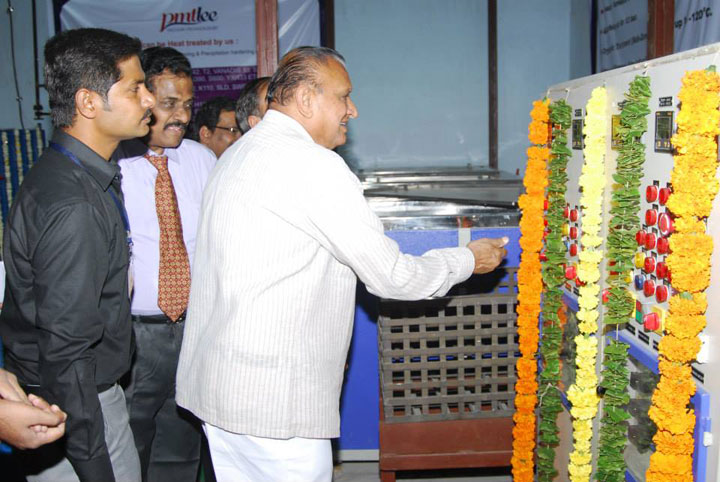
Our Company

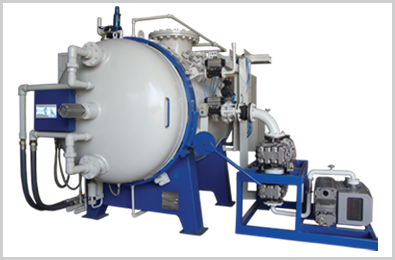
Just as choosing the correct die steel is very important, equally important is the proper heat treatment of the same. Proper heat treatment is critical to realize the full potential of the chosen alloy and also to retain the dimensional integrity of the heat treated tools. Our supplier offers Vacuum Furnaces, with know-how from COFI Spa, Italy, that can meet the demanding process specifications of the industry.

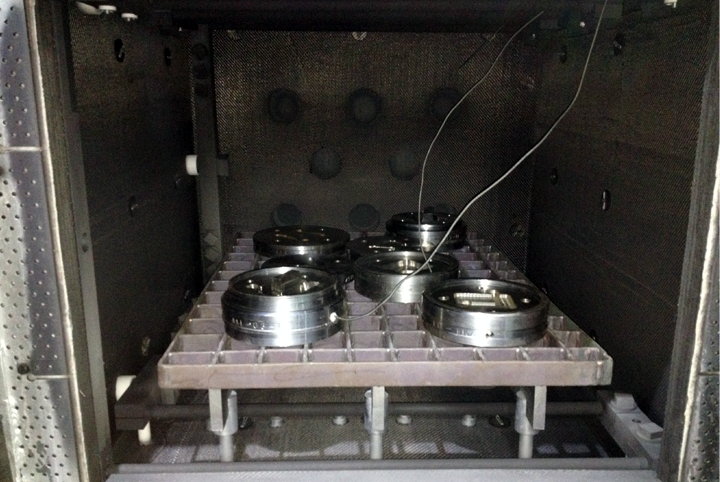
Our Vacuum Furnaces are suitable for a wide range of Heat Treatment for Tool and Die Steels including Hardening, Tempering, Annealing and Stress Relieving as well as Vacuum Sintering and Brazing. Heating is done under Vacuum up to 10-5millibar range and quenching is done in-situ using Nitrogen gas with pressures ranging up to 10 Bar (absolute).
Why Heat Treatment ?
  • To Increase/decrease Hardness, Strength ( Tensile and Proof ) and mechanical properties (Elongation, Reduction in area, Impact strength)
  • For Grain refinement, Transformation of products, Homogeneity of phases
  • To Stress relieve and remove work hardening effect
  • To Dissolve alloy constituents ( solutionizing) and aid in precipitation hardening thereby increasing hardness
  • To Improve corrosion resistance and wear resistance.
  • To Retain the shape for a long time
  • To Improve electrical conductivity
  • Reduce Brittleness and improve Toughness, Ductility, Malleability, Formability and Bending properties
Purpose of Heat Treatment
  • Relieve stresses after either hot or cold working
  • Improve ductility and shock resistance
  • Modify electrical and magnetic properties
  • Harden tools, dies etc.
  • Change the grain size
  • Increase resistance to heat and corrosion
  • Harden the surface by Change of chemical composition( as in Carburizing, Nitriding, carbonitriding tuffriding etc )
  • Fully stress relieve, Spheroidising and malleabilizing
  • Harden surface without change in chemistry ( Induction , Flame hardening )

Our Service

Vacuum Heat Treatment

A common use of a vacuum furnace is heat treatment of steel and alloys. Many general heat treating applications involve the hardening and tempering of a steel part to make it strong and tough through service. Hardening involves heating the steel to a pre-determined temperature, then cooling it rapidly.

Vacuum furnaces are ideal for brazing applications. Brazing is another heat-treating process used to join two or more base metal components by melting a thin layer of filler metal in the space between them.

What is Vacuum?

A rare fraction of molecule is called vacuum.
  • Atmospheric pressure is variable but standardized at 101.325 kPa (760 Torr)
  • Low vacuum, also called rough vacuum or coarse vacuum, is vacuum that can be achieved or measured with rudimentary equipment such as a vacuum cleaner and a liquid column manometer.
  • Medium vacuum is vacuum that can be achieved with a single pump, but the pressure is too low to measure with a liquid or mechanical manometer. It can be measured with a McLeod gauge, thermal gauge or a capacitive gauge.
  • High vacuum usually requires multi-stage pumping and ion gauge measurement.
  • Ultra high vacuum requires baking the chamber to remove trace gases, and other special procedures. British and German standards define ultra high vacuum as pressures below 10-6 Pa (10-8 Torr).

What are the materials Heat Treated in Vacuum Furnace?

  • High Speed Tool Steels - M2, M35, M42, T42, T2, Vanadis, SKH51 & ASP Grades, S390, S600 etc.s
  • Cold Work Tool Steel - D2, D6, A2, K110, SLD, Swerker 21, SKD11,SKD21, SV3 etc.
  • Hot Die Steels - H10A, H11, H12, H13, Orvar Supreme, Dievar, Dac10, Eskylos 2083, Eskylos 2738, W300, W302, W360, SKD SERIES, DAC SERIES, HP SERIES, STAVAX, CALMAX etc.
  • Stainless/ Plastic Mould Steels - SS420, SS440 C,Pptn. Hardening St. Steels, M300, P20, HPM Series, NIMAX etc.

Ultrasonic Cleaning

We take pride in the fact that we are the pioneers in introducing Ultrasonic Cleaning in today's fast changing technology and which is essential for an effective and scientific cleaning of the job prior to vacuum heat treatment & which is possible only with this technology thereby ensuring better heat treatment results.

What is Ultrasonic Cleaning ?

  • An ultrasonic cleaner is a cleaning device that uses ultrasound (usually from 20-400 kHz) and an appropriate cleaning solvent (sometimes ordinary tap water) to clean delicate items. The ultrasound can be used with just water, but use of a solvent appropriate for the soiling and the item to be cleaned enhances the effect. Cleaning normally lasts between three to six minutes, but can also exceed 20 minutes, depending on the cleanliness of the object.
  • Ultrasonic cleaners are used to clean many different types of objects like jewellers, lenses and other optical parts, watches, dental and surgical instruments, tools & dies, coins, fountain pens, golf clubs, window blinds, firearms, musical instruments and electronic equipment, industrial parts to remove corrosion, oxidation effects, deposition of foreign material (oil, grease, lapping paste). They are useful in vacuum heat treatment, plasma nitriding many jewellery workshops, watchmakers' establishments, and electronic repair workshops.

Cryogenic Treatment (Sub-Zero Quenching):

To convert and minimize the retained austenite and to gain full martensitic structure, for good strength and better mechanical properties this treatment is very much important and is to be followed immediately after Quenching. Our sub zero chamber is capable of attaining -1200C.

  • The correct term is 'cryogenic treatment', not cryogenic quench. The steel is QUENCHED immediately after austenitizing and it is not quenched in liquid nitrogen. In general, cryogenic treatment is referred to as 'cryogenic tempering' since it does transform retained austenite. Some professional heat treating services refer to it as that. It is wrong to refer to it as temper since it DOES NOT temper the martensite. The retained austenite transformed to martensite by cryogenics is NOT tempered and all usual tempering should be performed after the treatment. The first tempering should be performed immediately upon the steel warming to room temperature. To do it properly the steel should immediately be placed into cryo upon reaching room temperature for high alloy steels after a snap temper (which is performed immediately after the steel reaches approximately, but no less than, 125 F after quench). The snap tempering after quench is a preference of some and others skip the snap temper for high alloy steels and go straight to cryo immediately after the steel cools enough after quench.
  • The thing to remember about cryogenic treatment is: It will transform retained austenite into un tempered martensite. That is ALL it does. This un tempered martensite must be tempered, therefore all tempers except for a previous snap temper are performed after the cryogenic treatment.

Advantages of Cryogenic Treatment (Sub-Zero Quenching)

  • Reduces friction and wear properties as well as surface roughness
  • Alters and refines the molecular grain structure
  • Allows the machining of parts to tighter tolerances
  • Increases dimensional stability on critical components
  • Relieves stress fracturing
  • Provides for easier machining and redressing
  • Increases component durability and lifespan
  • Lowers replacement costs and downtime due to increased wear resistance

Vacuum Tempering

We have the Tempering Furnace with facility of not only Vacuum level of 10-1 m bar but also protective atmosphere of Nitrogen.

  • Also temperature-sensitive silicone rubber parts can be tempered (Tempering with 100°C!)
  • The vacuum process has an additional degree of freedom for process optimization.
  • It retains the advantages of vacuum hardening in terms of cleaner surface with low oxidation and decarburization effects thereby reducing the finish cleaning operations.
  • Heat exhaust" quantity is significantly reduced which means low emissions.
  • Very low contaminated industrial effluent
  • Only minimal odour problems (peroxides)
Multiple Facilities Under One Roof
  • Also temperature-sensitive silicone rubber parts can be tempered (Tempering with 100°C!)
  • The vacuum process has an additional degree of freedom for process optimization.
  • It retains the advantages of vacuum hardening in terms of cleaner surface with low oxidation and decarburization effects thereby reducing the finish cleaning operations.
  • Heat exhaust" quantity is significantly reduced which means low emissions.
  • Very low contaminated industrial effluent
  • Only minimal odour problems (peroxides)
Our Mission

Providing Vacuum Heat Treatment services with modern technology to our esteemed customers without any additional financial burden.

Our Vision

Others' future technology is our present technology.

CEO Intro

Mr.M.V. Sudakar,M.Tech.(Metallurgy)

The mentor of our company Mr. M.V. Sudhakar is a highly knowledgeable and pioneering individual. He possesses 25 years of experience in the Heat Treatment field and holds a M.Tech degree in Metallurgy. Under the dynamic and farsighted leadership of our CEO, we have already established a stronghold for ourselves in the field of conventional heat treatment of tools and die steels by providing high quality, reliable and prompt services to customers of Precision Metal Treaters, Precision Metal Technics and Sushmitha Metal Treaters in Hyderabad thereby earning high applause and eventually taking the 3 companies to the zenith of success. Under the able & inspiring guidance of our CEO, we are confident of achieving similar success in the field of vacuum heat treatment also

M. Bhanu Padhmaja

Managing Director

Equipped with a degree in Commerce from Bombay University and CA Inter and backed by an experience of 20 years as proprietor of Sushmitha Metal Treaters which is engaged in heat treatment of tools and die steels, she has been actively involved in the establishment of this project right from its inception

K.Shravan

Process Manager

An experienced metallurgical engineer, he is responsible for deciding and executing process parameters/heat treatment cycles to the satisfaction of our customers in terms of quality and delivery schedule..
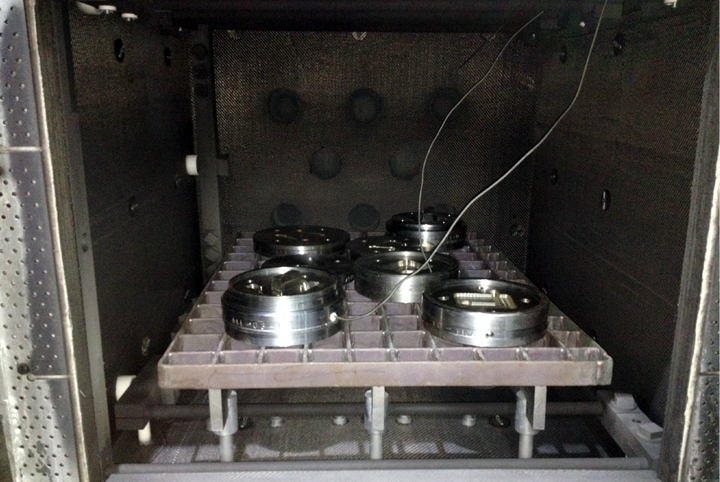
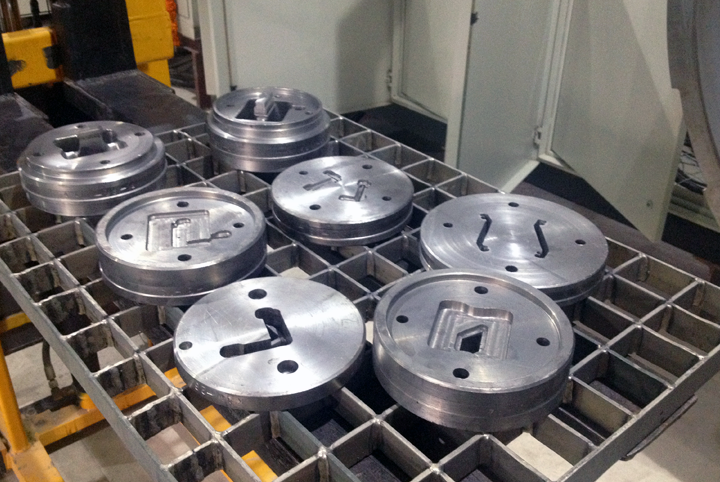
our Clients are at the core of our success. We are very proud of the work we do

Portfolio

Reach us

Your message has been sent. Thank you!
WORK ADDRESS
Shed No. D-26/B, Phase - IV Extn., I.D.A Jeedimetla, Hyderabad - 500 055 Tel: +91 40 6529 7529,4020 8288, Mobile : 098490 06115, 099666 97666.
REGISTERED ADDRESS
Block No. 8, Flat No. 703, Malaysian Township, K.P.H.B., Hyderabad - 500 085. Tel: +91 40 23156652.